

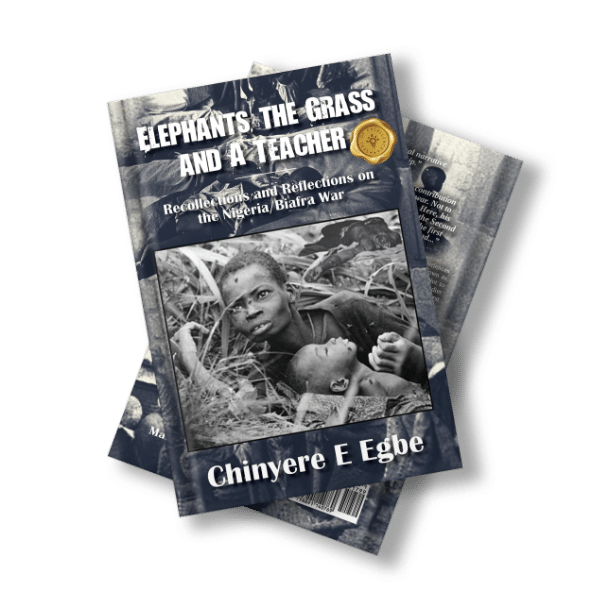
elephants, the grass and a teacher
by Chinyere E. Egbe
This book is a captivating rendition of Dr. Egbe’s personal and family experiences during the Nigerian Civil War (1967-1970). The book will equally go down as an audacious contribution to the historiography of the Nigerian civil war. Not to mention a crash program in military history. Here, his detailed rebuttal of Brigadier Alabi’s claim that the Second Punic War between Rome and Carthage was the first time elephants were used in battle, comes to mind.
Dr. Egbe presents several harrowing experiences and close calls with annihilation of his family. For example, after Dr. Egbe’s siblings and their mother were tied up to be executed by Nigerian soldiers in May 1969, one of the soldiers discovered a photograph in which their dad was pictured with the battalion commander who had sent them to arrest the family. Dr. Egbe concludes that the leaders of Nigeria and Biafra learned little or no lessons from the tragedy.

The Author
Chinyere E. Egbe
The Author
Chinyere E. Egbe

Dr. Chinyere Emmanuel Egbe is an economist and currently a tenured full professor of Business at Medgar Evers College (CUNY), where he has taught business statistics and finance since 1989. Dr. Egbe is also a Consortial faculty at the City University School of Professional Studies (SPS). At CUNY SPS, Dr. Egbe teaches Business Mathematics and also provides leadership in curriculum development.During his tenure at Medgar Evers College, Dr. Egbe held various positions. While he was dean, he led the school to gain national accreditation through the Accreditation Council for Schools of Business and Programs (ACBSP) in 2003 and continued to provide leadership to reaffirm the accreditation of the school’s business programs in 2013. Dr. Egbe also wrote proposals that established two new degree programs. Community leaders have also recognized Dr. Egbe for his contributions to community Development and awarded him Certificates of Special Congressional Recognition in 2001 and 2018.
Book Teaser
Less than six years after Nigeria gained independence, the nation was thrust into a traumatic 30-month civil war. This book recounts how my family overcame the immense challenges and traumas brought about by the conflict. I aim to connect these personal experiences to the broader dynamics of societies, political entities, and ruling establishments. Our story reflects not only our personal struggles but also those of ordinary Nigerians and people in similar societies.
The war’s challenges were akin to a living nightmare—like the time I found myself drenched by a heavy downpour in the middle of a tropical rainforest at night, wandering hopelessly. If the ordinary people heed my lamentations, perhaps there will be no more wars. I hope to have succeeded in remaining impartial, highlighting the flaws and missteps on both sides of this fratricidal conflict.