
incentive structures for factors of production, and price subsidies were cited to support the World Bank claim. On the other hand, the OAU claimed that Africa’s problems were due to external constraints beyond the control of African leaders and policy-makers. In particular, the effects of colonialism and trade barriers in the advanced countries, among others, were cited as constraints on the ability of African countries to participate in the international economic system.
Among other recommendations, the World Bank suggests that African countries should adopt an export-led growth strategy based on the export of agricultural raw materials. Since African countries face external constraints beyond the control of their leaders, the OAU recommends that they adopt an internally ropelled economic growth strategy. Such a strategy would include self-sufficiency in food production, and intra-African trade. In this paper it is argued that there is sufficient basis for understanding the apprehensions of the leaders of the OAU.
It has been thirteen (13) years since these initial propositions were made by the OAU and the World Bank. However, the issues raised by these two propositions continue to be relevant. Throughout the 1980s and even in the 1990s researchers and analysts have debated the merits of these propositions. Principal among these are Luke (1984), Ravenhill (1986) and Truett and Truett (1992). Even the World Bank ( 1984, 1989) has continued to reiterate its recommendations, though with minor modifications.
Plan of the Paper
In the next section, the objections of the OAU are discussed briefly. This is followed by a specification and estimation of the empirical model for the study. The results of the empirical estimation are also presented. The paper concludes with a summary and a discussion. There is no attempt to make policy recommendations.
THE OBJECTIONS OF THE OAU: A DISCUSSION
The leaders of the OAU expressed reservations about the World Bank proposal on the basis of historical experience. According to them, the export of agricultural raw materials by African countries is a colonial legacy, which has relegated African countries to a dependency position in the world economy.
Furthermore, from the experience of the last fifteen years, Africa’s terms of trade in world trade have declined substantially. This decline stems, in large part, from the fact that most African countries depend largely on the export of raw materials, agricultural as well as non agricultural. According to the World Bank Development Report, 1987, for example, the average decline in Africa’s terms of trade between 1965 and 1981 was 2.27%. This average includes the data for oil exporting countries whose terms of trade rose substantially during the same period. If the latter group is excluded, the data would have shown a more substantial decline.
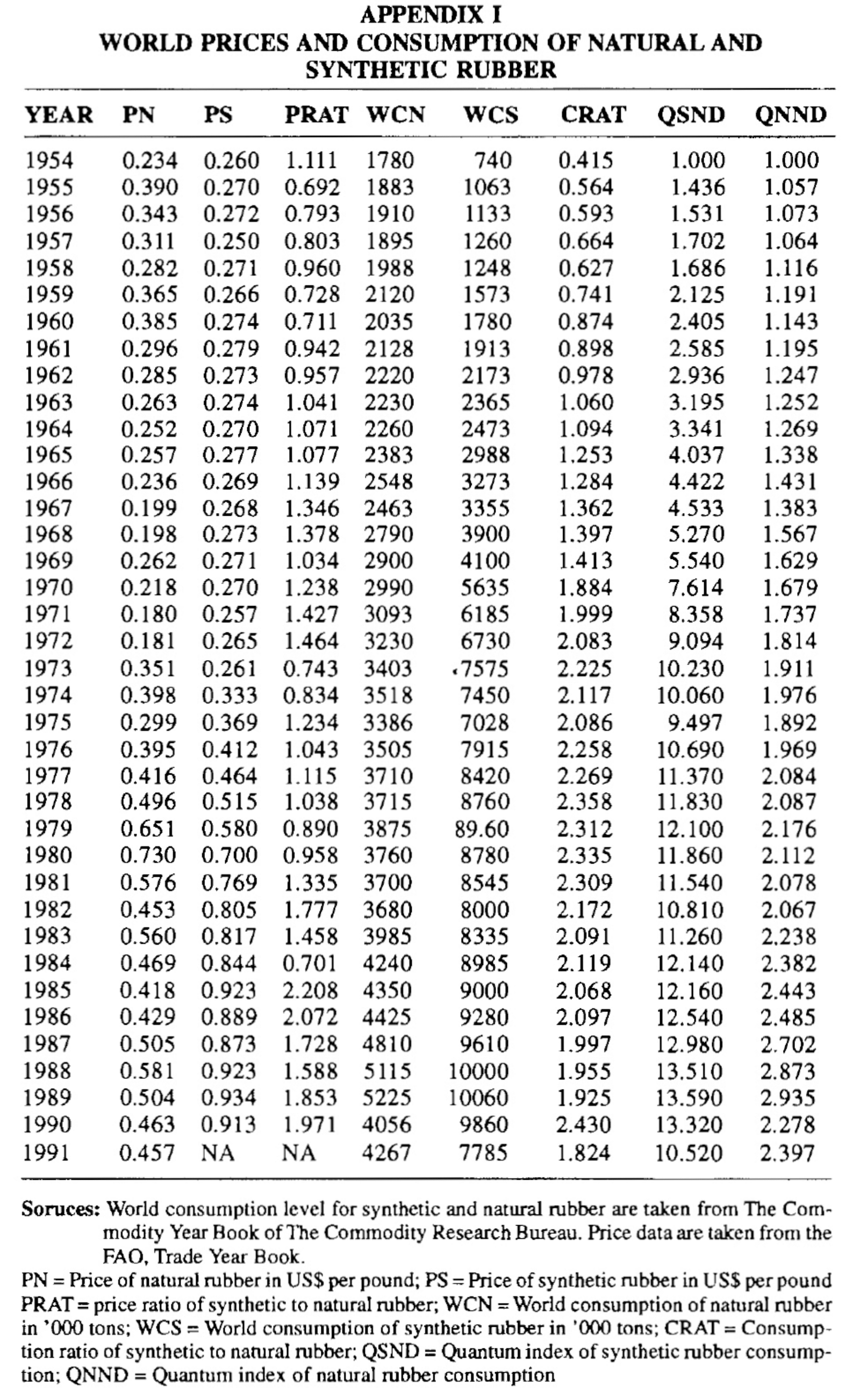
Another source of pessimism is the progressive development by the industrial nations, of technologies that are based against the use of agricultural raw materials. In some cases, like textiles and rubber goods, synthetic substitutes are developed. Between 1954 and 1991, for example, the price ratio of synthetic rubber to natural rubber increased persistently. At the same time the consumption of synthetic rubber went from 29% of world consumption to 68% of total world consumption of raw rubber. To make the point clearly, the consumption of synthetic rubber increased thirteen (13) fold from 740,000 tons in 1954 to more than 10,000,000 tons in 1989. On the other hand the consumption of natural rubber increased only two and half times, from 1,400,000 tons in 1954 to 5,000,000 tons in 1989 (See Appendix II). It is obvious that there has been a change in the preference function of the users of raw rubber, and that the shift to synthetic rubber is not primarily price induced.
In the case of edible products, temperate substitutes are developed to replace tropical products. The consequence has been a diminished share of world trade for agricultural raw materials in general, and maybe even more so for particular raw materials. Furthermore, the industrial countries have systematically substituted away from some African raw materials in favour of the same raw materials from other regions of the world. The implication is that Africa is being gradually pushed into the fringes of world trade, with her share of trade diminishing very rapidly. As such, the OAU argues that Africa cannot lay emphasis on world trade in agricultural raw materials as the primary engine of growth. She must seek internal solutions to her economic problems.
The points made by the OAU raise several issues that need to be clarified. The first question that arises is whether the advanced industrial countries are developing temperate substitutes to replace tropical agricultural raw materials, or replacing African sources with sources from other non African developing regions of the world. If the answer is yes, then what accounts for this development? Furthermore, if advanced countries are developing synthetic alternatives, can it be argued that export-led growth is no longer the appropriate strategy to accelerate African economic growth? 1\vo important issues are raised above. The first part of the question is the subject of the empirical section of this paper. The latter question derives from the first. Both questions are addressed briefly below.
Buyers of tropical raw materials may develop alternatives for security purposes, due to cost considerations, or to make up for inadequate supplies from traditional sources. Assuming that the industrial countries are developing alternative sources of raw materials, it does not imply·that autarky is preferable to trade. It would only imply that export-led growth should be based on some other sources of comparative advantage. However, the substitution away from tropical raw materials justifies the apprehensions expressed by the OAU, and a study of the problem and its implications. Against this background, it is the purpose of this paper to test whether there is a technical change bias against the use of imported natural rubber in the production function of the US rubber goods manufacturing industry. In particular, the translog cost function is used to study the substitution between domestic inputs (labour, capital, and synthetic rubber) and the imported input (natural rubber) in the manufacture of rubber goods in the United States. The results of the study then are used to argue that to a significant extent, the apprehensions of the leaders of the OAU may be justified. If the results of this study are extended to other raw materials this could lend further support to the disposition of the OAU. The implication of the results, would be that it may not be in the interest of the producers of rubber to emphasize its output when the buyers are making efforts to use less and less of it. In a study of eight commodities of export interest to African countries, Egbe (1991) found that there is a non-price induced bias in the industrial countries against importing agricultural commodities from African ountries in favour of buying from other developing countries.
THE CONTRIBUTION OF THIS ARTICLE
Beginning with the work of Burgess (1974a, 1974b), the translog production and cost functions have been used to study import demand functions in international trade. Burgess’s motivation was to overcome the limitations of linear and other non-flexible functional forms in the estimation of import demand functions. Burgess obtained results to reject the maintained hypotheses of previously used simple models. Mohabbat, Dalal, and Williams (1984) apply the same method and find specific results for India. Kohli (1978) and Applebaum and Kohli (1979) used the model to study trade relations between Canada the USA. The determine that the USA and Canada are not price takers in their trade with each other. They go on to discuss the implications of their results for the balance of trade between the USA and Canada.
In the models of previous studies one important question and its wider implications are not addressed. Specifically all the models examined except for Kohli (1978) assumed no technical change and constant returns to scale. Whereas Kohli (1978) explicitly included technical change in his model he assumes constant returns to scale and does not discuss the implications of technical change for the distribution of the gains from international trade in general. Secondly, previous models were restricted to the study of the primary inputs of labour, capital and an aggregate index of imports in the production of an aggregate index of output (GNP). None of the models examined the structure of production in specific industries or disaggregated input factors. This paper deviates from previous works in this respect, by studying rubber goods manufactured in the US, using domestic inputs of synthetic rubber, capital and labour and the imported input of natural rubber. Furthermore, the model of this study accounts explicitly for non-neutral technical change, which provides an interpretation in a different context. Rubber is chosen because it is an important agricultural raw material that is a significant source of export revenue for three African countries: Zaire, Liberia, and Nigeria.
The issues raised and the conclusions reached in this paper are not unique. However, I introduce a new and significant perspective as well as a new point. The recommendations of the World Bank are part of a vast literature that prescribes export-led growth as a means to rapid economic development in the developing countries. What is different in the World Bank recommendation is its focus on the export of agricultural commodities. The apprehensions of the OAU and the conclusions reached in this study can also be seen in the context of an equally extensive literature often referred to as the export pessimism literature. There is nothing pessimistic about this literature. It only calls for a critical evaluation of the export-led approach to economic growth.
The critical literature on export-led growth is extensive and well known. There is neither the need nor an attempt to review it here in its entirety. Circumscribed enthusiasm for export-led growth can be found in the works of Sampson and Yeats (1977), Sampson (1980), Cline (1982) and Clark (1993). These writers point to non-tariff barriers (NTBs) that are used by advanced industrial countries to limit the imports of goods from the developing countries. Even when special agreements are made, sufficient clauses are included in the agreements which make it difficult for the LDCs to take full advantage of the provisions of them. Tumlir (1987), for example, doubts whether the Generalized System of Preferences (GSP) is of any benefit to the developing countries when discriminatory restrictions could be triggered by the export of goods for which the developing countries have comparative advantage. Truett and Truett (1992) sup.port Tumlir’s doubt by showing that the potential benefits of the GSP to selected African LDCs are minimal due to the competitive needs provision of the GSP agreement.
In the context of agriculture based export-led growth, Sampson and Yeats (1977) show that the Common Agricultural Policy (CAP) of the EEC countries reduces the demand for agricultural imports from the developing countries. Beyond NTBs Lewis (1981) doubts whether LDCs should depend on the export of agricultural commodities when world trade may be declining and at the same time the advanced industrial countries are not growing sufficiently to absorb the agricultural exports of the developing countries. Lewis further argues that agricultural exports may be good for a few LDCs, but it may not be so advisable for all LDCs as a group. Cline (1982) makes a similar argument with regard to manufactured goods exports. Kimenyi (1988) support Lewis (1981) by applying the HeckscherOhlin theory and game theory to show that Kenya’s terms of trade declined while Kenya increased its production and export of coffee over the period 1963-1982. Finally, Geiger (1991) provides additional evidence to show, among other results, that agricultural exports may not provide the impetus of leverage that will propel rapid growth in the LDCs. In particular, Geiger argues that the structure of world trade is such that agricultural exports lack the forward and backward linkages that are essential for accelerated growth in developing country economies.
It is within the context of this critical literature that this paper adds a new point. In addition to protectionist measures, the limitations of growth in the developing countries and competition from other LDCs (the Fallacy of Composition), rational economic decisions and technological changes could pose barriers that limit the potential of agricultural exports as an engine of growth. Developing cheaper substitutes and technologies that favour their use are rational economic decisions. The advanced industrial countries cannot be criticised for such rational economic actions in their own interest. At the same time, however, the developing countries have understandable reasons to be apprehensive.
In the context of the present debate about the relative merits of proposals of the OAU and the World Bank, the significance of this study cannot be overemphasised. It must be pointed out that a single commodity cannot be used to prove a general proposition. This is only an illustration of a plausible point.
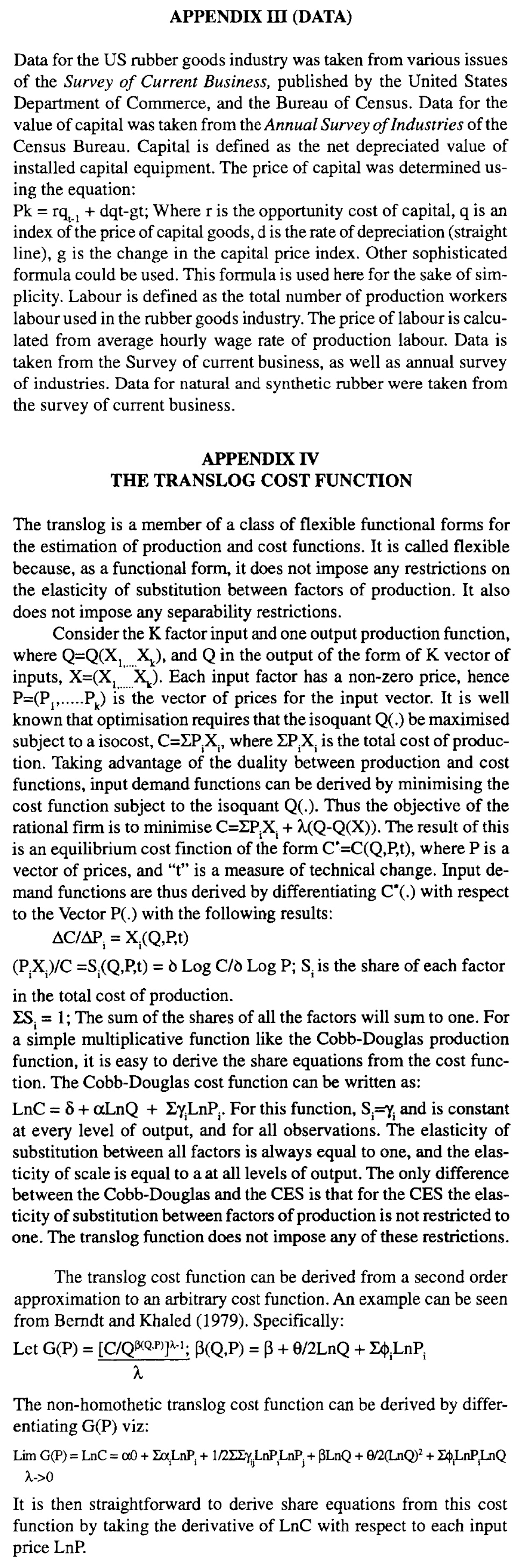
Consider the one product translog production function: (Christensen, Jorgensen, and Lau, 1973)
Let LnQ(X) = a0 + ΣaiLnXi + ΣaijLnXiLnXj (1)
Where Q is some output quantity on an isoquant, and X = (X1, …, Xk) is a K vector of inputs with corresponding prices P = (P1, …, Pk). A corresponding, though not dual, total cost function is:
LnC(Q, P) = b0 + ΣbiLnPi + ΣΣbijLnPiLnPj + d1LnQ + d2(LnQ)2 + ΣgiLnPiLnQ (2)
The following restrictions are imposed:
Σbi = 1; Σgi = 0; Σbij = Σbji = ΣΣbij = 0;
LnC(t, P, Q) = LnC(P, Q) + T(t, P)
Where: T(t, P) = m1Lnτ + m2(Lnτ)2 + ΣriLnPiLnτ (3)
If technical change is constant and Hicks neutral m2 = 0, and ri = 0 for all i. Technical change is factor i using or saving depending on whether gi > 0 or < 0 respectively.
Model Estimation
In the present study a total variable cost functions is specified and estimated. The model uses the US rubber goods industry to illustrate the bias in favour of domestic inputs against imported inputs. The purpose of the model is to determine if there is biased technical change in favour of synthetic rubber, capital, and labour, and against imported natural. The model is estimated using the joint generalised least squares (JGLS) procedure, through share equations. Data for the estimated equations is taken from various sources (See Data Appendix).
Let: C=C(Pk, Pl, Ps, Pn, Q, t); be the total cost function of producing rubber goods in the USA, with price arguments for capital, labour, synthetic rubber, natural rubber, respectively. Q is an index of output, and t is time, an index of technical change. The share equations are:
        Sn = an + ΣaijLnPj + dnLnQ + gnLn t
        Sn = an + ΣaijLnPj + dnLnQ + gsLn t
        Sn = an + ΣaijLnPj + dnLnQ + glLn t
        Sk = ak + ΣakjLnPj + dkLnQ + gkLn t
The purpose of the model is then to determine if technical change in the US rubber goods industry is biased against the use of the imported input, natural rubber.
If technical change is induced, and neutral then ri=0 for all i. The implication of factor neutral technical change is that there is an equiproportionate change in the elasticity of substitution between factors of production for any changes in their price ratios. In biased technical innovation, technical change overcompensates for the change in relative prices. Therefore the price of a factor of production may rise while its share of total cost rises, because technology is designed to use more of it and still be efficient. In this case gi>0. If technical change is factor i saving, then gi<0. If it is determined that technology has changed in favour of synthetic rubber, this implies a progressive redistribution of returns to it and against imported factors of production, in this case natural rubber.
Empirical Results
The results of the estimated equations are presented and discussed briefly. This is followed by estimates of own price elasticities of demand. For all models only the share equations are presented. It should be noted that the slope coefficients of the input share equations, except for the coefficient of time (“t”), do not have much intuitive economic meaning. However, they are related to the Allen Uzawa Partial Elasticities of Substitution (AUPES) which are calculated as:
        wij = (bij) / SiSj + 1
        wii = (bii / Si2) + 1 - (1 / Si)
The own price elasticity of demand is calculated as:
eii = wii Sj
THE US RUBBER GOODS INDUSTRY
        Sk = .415 + .020LnPk - .031LnPn + .009LnPs + .001LnPl + .040LnQ - .0084Lnt (8)
             (3.49) (4.29) (-7.34) (1.78) (0.25) (7.85) (-1.90)

        Ss = .207 + .009LnPk - .016LnPn + .017LnPs - .011LnPl - .069LnQ + .0448Lnt (9)
             (9.72) (1.78) (-2.72) (1.57) (-3.98) (-8.66) (6.41)

        Sn = .329 - .031LnPk + .091LnPn - .016LnPs - .044LnPl + .019LnQ - .0387Lnt (10)
             (23.0) (-7.34) (12.56) (-2.72) (-0.98) (2.87) (-6.80)

        Sl = .165 + .001LnPk - .044LnPn - .011LnPs - .032LnPl + .011LnQ + .002Lnt (11)
             (14.7) (-0.25) (-0.98) (3.98) (3.04) (1.48) (0.16)

        R² = .998 (This is the coefficient of determination for the system of equations), F=424.43;
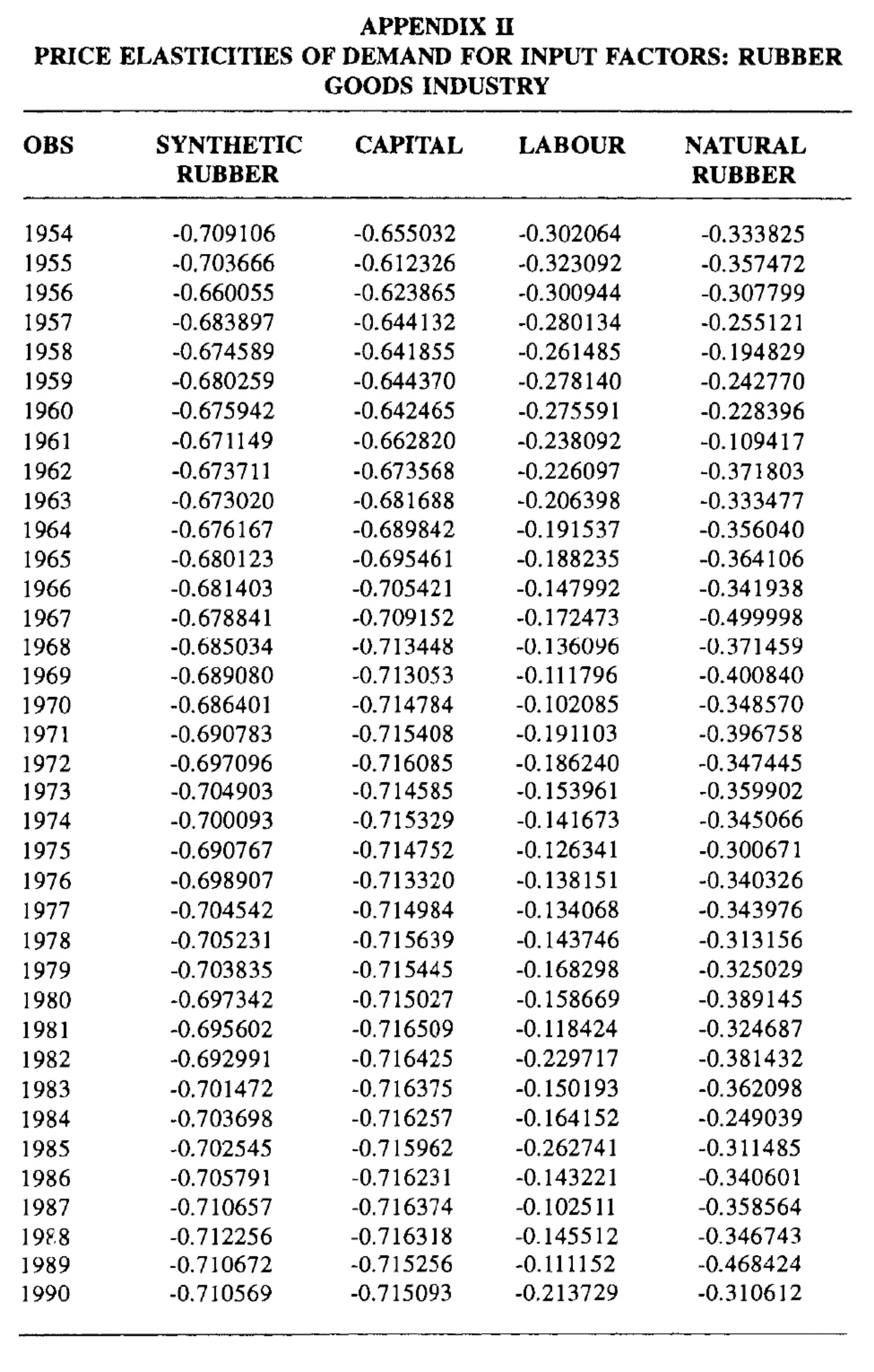
The cost function for the US rubber goods industry is homogeneous of degree one in prices, and positive in all input prices. The own price elasticities of demand (EKK for capital, ELL for labour, ESS for synthetic rubber, ENN for natural rubber) for the inputs factors (See Appendix II) are all negative, as expected. The share equations show that there is a progressive technical bias against the use of imported natural rubber, and in favour of the domestic factors, labour, and synthetic rubber. The bias parameters are respectively, -.0386, +.0448, and +.002. The results also show that a change in the price ration will induce a substitution away from capital, with a bias parameter of -.008. This result is somewhat surprising. However, a similar result has been obtained, for Japan, by Kuroda, Yoshioka, and Jorgensen (1984 ). Compared to natural rubber, however, rubber goods technology over time has been capital-using and natural rubbersaving, with a relative bias factor of .0467 (see Kang and Kwonk 1988). The most important observation, however, is the bias against the imported input, natural rubber.
CONCLUSIONS
The purpose of this paper was to extend the discussion of the prospects for export-led growth in Sub Saharan Africa. African leaders in the Lagos Plan of Action expressed reservations about the World Bank’s proposal for an agriculture based export-led growth.
According to the OAU, such a strategy, is not consistent with the achievement of Africa’s long-term goal of extricating herself from the vicissitudes of demand for raw materials from the advanced industrial countries. In addition, research has shown that the price elasticity of demand for agricultural raw material is low. The implication is that expansion of the output of agricultural raw materials will depress prices even more, and result in lower revenues. The problem is made worse by the fact that the advanced countries are developing alternatives to the raw materials, and where possible synthetic alternatives are developed. In this paper it is shown that there has been a progressive bias in technical innovation against the use of natural rubber, in favour of synthetic rubber and domestic labour. As such, a decrease in the price of natural rubber relative to synthetic rubber and labour will lead to redistribution of income in favour of synthetic rubber and labour. Since natural rubber is an imported input this would imply a redistribution of the gains from trade against those developing regions of the world that export rubber to the US. A further implication is that developing countries would have to reduce their prices substantially in order to increase their total revenues from exports. The result being that their terms of trade with the advanced industrial nations will deteriorate even more.
In the final analysis the issue in the OAU-World Bank dialogue is not a choice between comparative advantage or some irrational decision criteria. It may be that Africans have a comparative advantage in the production of agricultural raw materials. The problem is that the export of these raw materials may not hold out much hope as a source of rapid accumulation for developing countries in general, and for African countries in particular.
The observed bias against the purchase natural rubber does not necessarily justify an argument against agriculture-based export-led growth. However, it puts the problem in its proper perspective. Other sources of comparative advantage must be sought. What emerges from the debate so far is the reluctance of the industrial nations to genuinely assist the developing countries in achieving real economic development through industrialisation. If agricultural raw materials are produced more advantageously in African countries, then their final products should be processed in Africa and exported to the industrial nations. This, in my view, will give additional and more significant impetus to economic growth in the developing countries. However, in the absence of export markets in the industrial nations, Africans must find a way to galvanise their economies from within and trade with the external world at the margin.
REFERENCES
Berndt, E.R. and Khaled, M. “Parametric Productivity Measurement and The Choice Among Functional Forms”, Journal Of Political Economy, 1979.
Binswanger, Hans, P., “A Cost Function Approach to the Measurement of Factor Demand and Elasticity of Substitution”, American Journal Of Agricultural Economics”
_____________ , “The Measurement of Technical Change Biases With Many Factors of Production”, American Economic Review, 1974.
Burgess, D.F., “Production Theory and The Derived Demand for Imports” Journal of International Economics
_____________ , “A Cost Minimisation Approach To Import Demand Equations”, Review of Economics and Statistics, 1974.
Christensen, L.R., Jorgensen, D.W., and Lau, L.J., “Transcedental Logarithmic Production Frontiers”, Review of Economics and Statistics, 1973.
Commodity Research Bureau, Commodity Year Book, New York, Various Issues.
Clark, Don P., “Non Tariff Measures and Developing Country Exports”, The Journal Of Developing Areas, January, 1993.
Cline, William, “Can The East Asian Model Be Generalized?”, World Development, 1982.
Egbe, Chinyere, “Agricultural Exports, And The Agenda For Accelerated Development in Africa”, The Review of Black Political Economy, Fall 1991.
Geiger, L.T., “Evaluating Export Expansion Strategy for Economic Development: Selected LDCs, The Eastern Economic Journal, July 1991.
Grilli, E., Agostini, B.B., and Hooft Welvars, M.J., The World Rubber Economy: Structure, Changes, and Prospects, World Bank Staff Occasional Papers, #33, Washington, DC, 1980.
Grilli, E., Helter line, R., Pollak, P., “An Econometric Model of the World Rubber Economy”, World Bank Staff Commodity Paper, #3, Washington DC, 1979.
Grilli, E., and Yang, M.C., “Primary Commodity Prices, Manufactured Goods Prices, and the Terms of Trade of Developing Countries: What the Long Run shows”, The WJrld Bank Economic Review, January 1988.
Higott, R., “Africa and The New International Division of Labour”, in Ravenhill, Ed., Africa in Economic Crisis, Columbia University Press, NY, 1986.
Kang, J.M., and Kwon, J.K., “An Estimation of Import Demand, Export Supply, and Technical Change For Korea”, Applied Economics, 1988.
Kholi, U.R. “A Gross National Product Function and The Derived Demand
For Imports and supply for Exports”, Canadian Journal of Economics, 1978,
Kholi, U.R., and Applebaum, E. “Canada United States Trade: Tests For The Small Open Economy Hypothesis”, Canadian Journal of Economics, 1979.
Kimenyi, M.S., “International Trade, Immizerising Growth, and The Prisoner’s Dilemma: Evidence From Kenya”, Eastern African Economic Review, 1988.
Kuroda, M., Yoshioka, K., and Jorgenson, D.W., “Relative Prices and Biases of Technical Change in Japan”, The Economic Studies Quarterly, Aug. 1984.
Luke, D.F., Eds. Continental Crisis, The Lagos Plan of Action and Africa’s Future, Center For African Studies, University Press of America, 1984.
Lewis, Arthur, W., “Development Strategies in A Limping World Economy”, Proceedings of The 17th International Conference of Agricultural Economists, Gower Publishing, 1981.
Mohabbat, K.A., Dalal, A., and Williams, M., “Import Demand Function For India: A Translog Cost Function Approach”, Economic Development and Cultural Change, 1984.
Organization For African Unity (OAU), Lagos Plan Action for The Economic Development of Africa: 1980-2000, Addis Ababa, 1980.
Ravenhill, John, “Collective Self Reliance or Collective Self Delusion: Is The Lagos Plan a Viable Alternative?” in Ravenhill, J. Ed. Africa in Economic Crisis, Columbia University Press, NY, 1986.
Sampson, Gary, “Contemporary Protectionism And Exports of Developing Countries”, World Development, 1980.
Sampson, Gary, and Yeats, A.J., “An Evaluation of The Common Agricultural Policy as a Barrier Facing Agricultural Exports to The European Economic Community”, American Journal of Agricultural Economics, February 1977.
Stevenson, R., “Measurement of Technological Bias”, American Economic Review, 1980.
Truett, D., and Truett, L., “Non Primary Exports of African LDCs: Have Trade Preference Helped?”, The Journal of Developing Areas, July 1992.
Tumlir, Jan, “International Trade Regimes And Private Property Rights”, Contemporary Policy issues, April 1987.
United States Department of Commerce, The Survey of Current Business, Washington DC, Various issues.
United Census Bureau, Annual Survey of Manufactures, Washington DC, Various Issues.
World Bank, Sub-Saharan Africa: From Crisis to Sustainable Growth, Washington, DC, 1989.
______________ , Toward Sustained Development: A Joint Program For Action for Sub-Saharan Africa, Washington, DC, 1984.
_____________ Accelerated Development in For Action, Washington DC, 1981.