
elephants, the grass and a teacher
by Chinyere E. Egbe
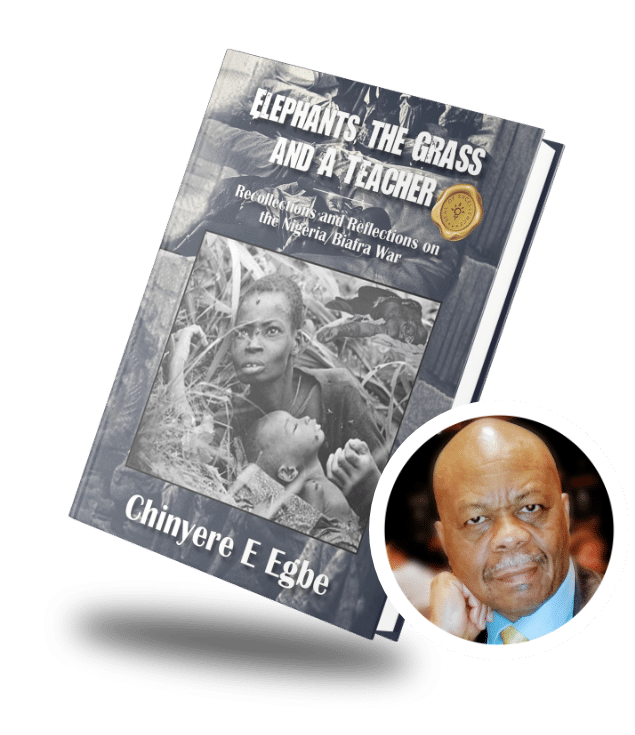
In this book, Elephants, the Grass, and a Teacher, Dr. Egbe presents a masterful rendition of his experiences during the Nigeria / Biafra War. Though the book is a captivating rendition of Dr. Egbe’s personal and family experiences, it is equally a masterpiece of integrative analysis of personal experiences within a complex conundrum of national events, the history and experiences of the Igbos within domestic and global politics.
The book begins with Dr. Egbe’s rueful soliloquy one day after the war ended where he lamented that after all the bloodshed, the suffering of the masses, the war ended uneventfully as if it was all about a masquerade spectacle. In Dr. Egbe’s position, whoever should start a war in Nigeria during his lifetime, that person and his or her family will be the ones to go and sleep in the trenches and exchange fire and dodge bullets. For, in the end, the people who died during the war were the poor farmers in the villages, the common laborers, and the market traders in the urban areas. Those who died of starvation were the poor malnourished children of low-income villagers.
Dr. Egbe presents several harrowing experiences and close calls with the annihilation of his family. For this reason, the title of the book is the Elephants, the Grass, and a teacher. The Elephants represent the privileged, the Grass the Masses and the Teacher represented his father (a celebrated teacher) who, both by his presence and even in his absence, saved and shielded the family from annihilation. For example, after Dr. Egbe’s siblings and their mother were tied up to be executed by Nigerian soldiers in early May 1969 (they missed Dr. Egbe narrowly), one of the soldiers discovered a photograph in which their dad was pictured with the very battalion commander who had sent them to go and arrest the entire family. Moreover, one of the division commanders in the war was also in that same picture.
Another hallmark of Dr. Egbe’s book is the objectivity of his analysis. He calls on the Nigerian side to put themselves on the side of the Biafrans in September 1966 and also asks the Biafrans how they would feel if their leaders were murdered on January 15, 1966. During the war, he calls on the Igbos to be more realistic about international diplomacy and how much diplomatic support they should have expected from outsiders, and questions the grudge that the Igbos held against Awolowo.
The documentary
by Khatri Productions
This Week in America with Ric Bratton

A must-read for those intending to understand the intrigues, actions, especially from the Nigerian side as well as the personal interest of the key players. I recommend the book for schools libraries, individuals, and those intending to further research works.
Commander Ochiabuto Igbokwe, Nigerian Navy rtd
I believe that this book will serve the need of future generations who would wish to know the truth about the civil war, the Professor who wishes to educate his students from the perspective of historical facts, and a reader seeking knowledge about the great Igbo race of Nigeria and the basis for their continued aspiration for a country they can call theirs.
Lawrence Nwagbara, Houston, Texas the USA.
Egbe’s Elephants, The Grass, and a Teacher could be classified as historical war writing infused with informed analysis. His analysis positions him as a teacher reminding the citizens of the evils and fruitlessness of war. He moralizes on the Nigeria Biafra war where the elephants (herein the ruling class and the privileged) begin a war but the grass (herein the general population) suffers the pangs of war.